

An Electronic Key Management System (EKMS) is a controlled, auditable, and policy-driven method of managing physical keys through secure electronic cabinets and centralized software. For organizations with distributed facilities, high staff turnover, regulated operations, or strict visitor control, EKMS replaces informal key registers and manual handovers with authenticated access, real-time visibility, and enforceable accountability.
As part of broader access control management, an EKMS helps ensure that sensitive areas (data centres, labs, cash rooms, server rooms, plant rooms, and critical infrastructure) remain accessible only to approved personnel, at approved times, for approved purposes—while maintaining a defensible audit trail.
Understanding Electronic Key Management Systems (EKMS)
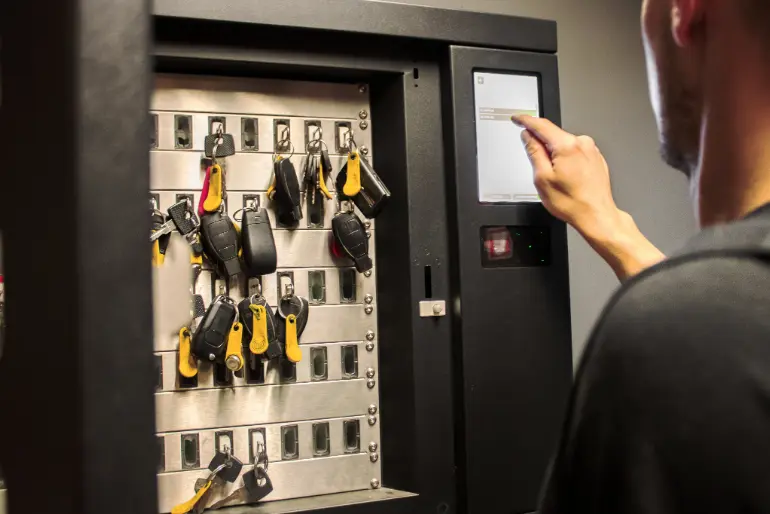
At its core, an EKMS combines physical security hardware with software that governs who can take which key, when, and under what conditions. Keys are stored in a secured cabinet (or multiple cabinets across sites) and are released only after user authentication and authorization checks.
Unlike traditional key cupboards, an EKMS continuously records key transactions—issuance, return, exceptions, and overdue events—enabling security teams, facility managers, and compliance stakeholders to monitor adherence to policy and investigate incidents efficiently.
How an EKMS Works: Core Components
Most key management solutions include the following components:
- Secure electronic key cabinet: Tamper-resistant enclosure with controlled key slots or key tags.
- User authentication: PIN, smart card, mobile credential, or biometrics, depending on risk profile.
- Authorization rules: Role-based access, time schedules, dual authorization, and escalation policies.
- Management software: Central console for configuration, monitoring, reporting, and audit logs.
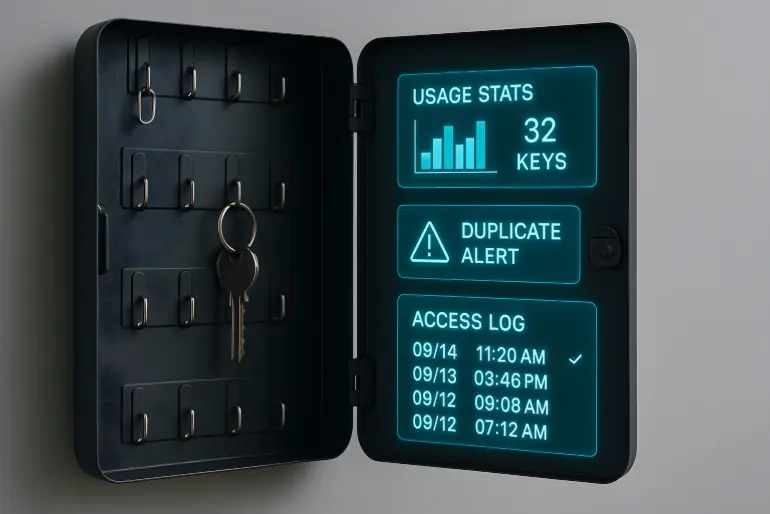
- Eventing and alerts: Overdue keys, forced access attempts, policy violations, and maintenance notifications.
Operationally, a user requests access; the system validates identity and permissions; the cabinet releases the assigned key; and the transaction is logged with timestamp, user identity, and key identifier. On return, the system confirms reinsertion and closes the loop, supporting reconciliation and exception handling.

Business and Security Benefits
For professional environments, the value of an Electronic Key Management System extends beyond “finding keys faster.” It formalizes governance, reduces operational friction, and strengthens investigations.
- Improved security posture: Reduces unauthorized key access and limits uncontrolled key duplication.
- Strong accountability: Clear ownership of each key movement, supporting disciplinary and corrective action when required.
- Operational efficiency: Faster issuance/return and reduced administrative overhead for security and facilities teams.
- Audit readiness: Reliable logs support internal controls, incident analysis, and compliance requirements.
- Reduced risk and cost: Lower frequency of lost keys, rekeying, and disruption to operations.
EKMS as Part of Access Control Management
Modern access control management typically addresses doors, turnstiles, elevators, and identity. Physical keys, however, remain a persistent gap—especially for legacy mechanical locks, back-of-house spaces, electrical panels, and emergency overrides.
EKMS closes this gap by applying the same governance principles used for electronic access: least privilege, time-bound permissions, approvals, and monitoring. When aligned to access control policies, EKMS helps security leadership demonstrate end-to-end control over both electronic credentials and mechanical keys.
Typical Use Cases in India (Enterprise and Regulated Environments)
In India, organizations commonly deploy EKMS across:
- IT/ITES and data centres: Controlled access to cages, server rooms, and MEP infrastructure; improved traceability during change windows.
- Manufacturing and utilities: Keys for plant rooms, substations, tool cribs, and safety-critical areas with shift-based access.
- Healthcare: Restricted access to pharmacies, stores, and labs, with audit trails for accountability.
- BFSI and retail: Vaults, ATMs, cash rooms, and high-risk storerooms with dual control workflows.
- Education and campuses: Centralized key governance across buildings, departments, and contractors.
Integration with Security Infrastructure
EKMS delivers the highest control when integrated into the wider security ecosystem. Common integrations include:
- Access control platforms: Shared identity, roles, and schedules to keep policies consistent.
- Visitor management systems: Contractor key access tied to approved visits, permits, and valid ID proofing.
- CCTV and video management: Correlation of cabinet events with video evidence for investigations.
- Incident and alarm monitoring: Automated creation of alerts for overdue keys or cabinet anomalies.
This layered approach strengthens detection and response, while improving governance across sites and teams.
How to Evaluate Key Management Solutions
When selecting an Electronic Key Management System, assess requirements through a risk-and-operations lens rather than purely by cabinet capacity.
- Policy fit: Role-based access, shift schedules, approvals, dual custody, and emergency workflows.
- Scalability: Multi-cabinet and multi-site management with centralized reporting.
- Authentication options: Support for biometrics/smart cards/mobile credentials based on the threat model.
- Resilience: Offline operation, power contingency, and secure data synchronization.
- Reporting and audit: Searchable logs, exportable reports, exception dashboards, and retention controls.
- Integration: Standards-based interfaces with access control management, VMS, and IT systems.
- Implementation and support: Site surveys, commissioning, training, and after-sales support/AMC.
Implementation Best Practices
To realize measurable outcomes, organizations should implement EKMS with clear governance:
- Define a key policy: Key classifications (critical/non-critical), access rules, and exception handling.
- Establish ownership: Assign responsibility across security, facilities, and department heads.
- Clean up the key inventory: Tag keys, document lock locations, and retire duplicates.
- Configure alerts and KPIs: Overdue thresholds, peak usage windows, and compliance reporting cadence.
- Train users and supervisors: Focus on operational discipline and incident reporting workflows.
Conclusion
An Electronic Key Management System is a practical, high-impact control that brings governance, traceability, and operational discipline to physical keys—often one of the last unmanaged elements in enterprise security. When deployed as part of integrated access control management, EKMS helps organizations reduce risk, improve compliance, and run facilities more efficiently, particularly in multi-site and high-security environments.
Ready to improve secure key management? Contact Bion Analytx for a structured assessment and an Electronic Key Management System (EKMS) approach aligned to your facility, compliance needs, and operational reality.
Frequently Asked Questions
Q: What is an electronic key management system (EKMS)?
A: An EKMS is a hardware-and-software solution that stores keys in a secure cabinet or locker and controls access to each key. Users authenticate before a key is released, and every issue/return is logged automatically with the user name/ID and a timestamp.
Q: How does an Electronic Key Management System work?
A: An EKMS authenticates users through PINs, smart cards, biometrics, or mobile credentials before releasing authorized keys. Every key issue and return is automatically logged, creating a real-time audit trail for monitoring and compliance.
Q: What are the benefits of an Electronic Key Management System?
A: An EKMS improves security by preventing unauthorized key access, reducing lost keys, automating audit trails, increasing accountability, and simplifying compliance across enterprise facilities.
Q: Can an EKMS integrate with access control and CCTV systems?
A: Yes. Modern Electronic Key Management Systems integrate with access control, CCTV, visitor management, and video management systems, enabling centralized monitoring and faster incident investigation.
Q: What should you consider before choosing a key management solution?
A: Evaluate key capacity, authentication methods, multi-site scalability, reporting capabilities, system integration, deployment options, and after-sales support to ensure the solution meets your operational and security requirements.
Q: How can Bion Analytx help with electronic key management?
A: Bion Analytx helps organizations implement secure electronic key management solutions integrated with access control and video surveillance. Our solutions improve key accountability, strengthen compliance, and provide real-time visibility across enterprise facilities.
Talk to our security experts: marcomm@bion.co.in